

A Whole-System View

The systems behind technology
are increasingly interconnected.
Our understanding and our
actions must be too.

Today’s decisions about technology shape the materials, manufacturing, energy, water and workforce behind it.

Industrial capability is more than factories. It is accumulated knowledge, specialized infrastructure, trusted relationships and market pathways built over generations. Once lost, it cannot simply be switched back on. The Technology Stewardship Alliance unites the people who hold these pieces, brings the full system into view and enables the action needed to preserve, rebuild and advance the capabilities technology’s future depends on.

Why Technology Stewardship Now

The Technology Stayed in View.
What Made It Possible
Faded into the Background.

Globalization expanded what technology could achieve. Alongside specialization and outsourcing, it spread materials, production and expertise across industries and borders. The products remained visible. The increasingly complex network of knowledge, capabilities and relationships supporting them became far less understood.

Those dependencies are now being tested. The push to secure supply chains and rebuild domestic capabilities is revealing that industrial capacity cannot be restored through investment or relocation alone. It depends on materials, equipment, process knowledge, qualification pathways, skilled people and markets working together. Meeting the moment demands a shared response.

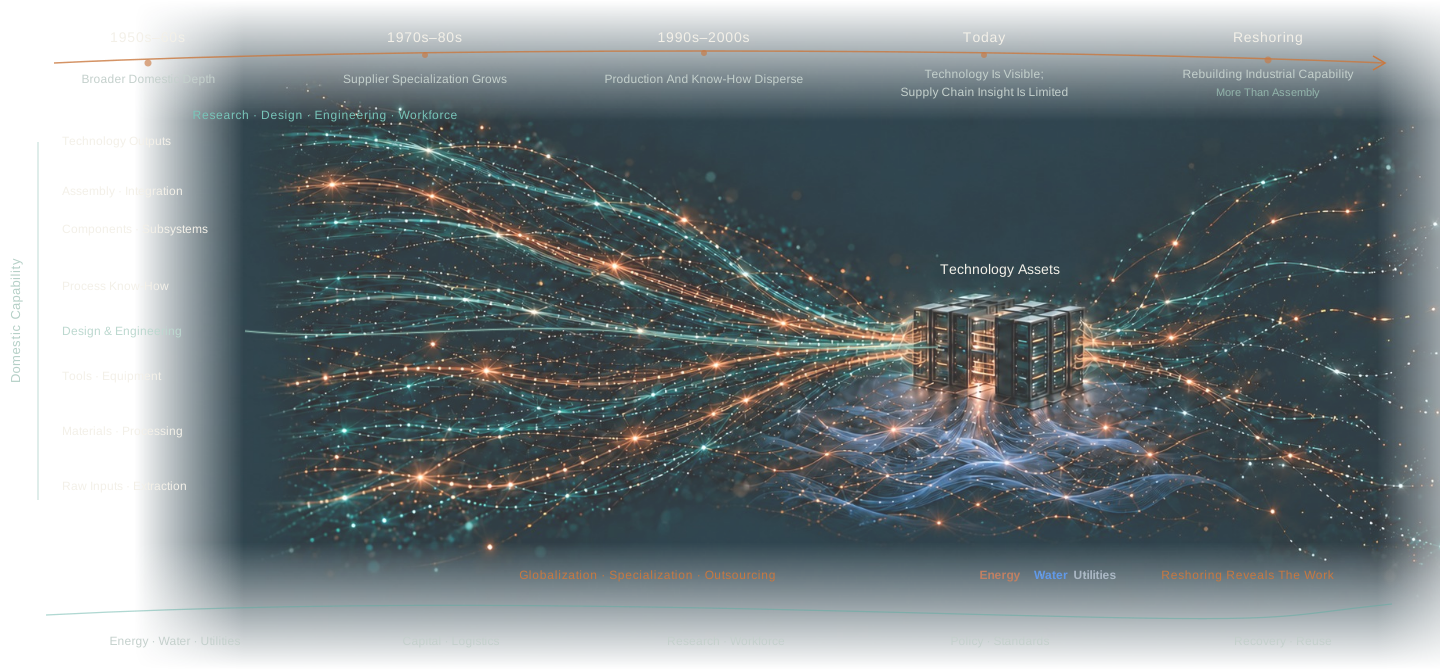
An illustrative technology value chain with seven distinct supply chain layers, a continuing Design and Engineering thread and a Domestic Capability axis. Lines gradually narrow into Today around visible Technology Assets, represented by a compute cluster. Outgoing supply chain paths are partial and broken, showing the work of reconnecting materials, equipment, workforce and infrastructure. Beneath the assets, an abstract field represents energy, water and utilities.
A conceptual view of domestic capability, declining visibility and the work of reconnecting. The cluster represents visible technology assets; the distinct lines represent the supporting value chain. This is not a measured historical chart. View the Full Graphic ↗

How the Alliance Works

Bring the Right Expertise to the Work That Matters.

So many stakeholders shape technology today, yet no single organization sees or controls the whole system. Meeting today’s demands and preparing for what comes next requires a unified approach that brings together the knowledge, capabilities, influence and vision needed to determine what is possible.

The Alliance serves as an orchestration layer across the systems and stakeholders that make technology possible. It provides an essential platform to deliver outcomes that can no longer be achieved by a single organization or through the siloed structures in which we operate today. In doing so, it turns individual contributions into the shared capacity to act, innovate and lead.

01

Working Groups

Bring together expertise around designated focus areas to pursue time-bound missions established with the Alliance’s governing body. Each group identifies dependencies, aligns priorities and produces defined deliverables across organizational and sector boundaries. Knowledge flows between groups so progress in one area strengthens the whole.

02

Research, Education & Innovation

Convene academic and research institutions alongside industry and public-sector expertise to build, preserve and transfer the knowledge needed to strengthen industrial capability and open new pathways for innovation.

03

Convenings & Policy Insight

Bring cross-sector evidence and experience into dialogue with government, trade associations and standards bodies, helping shape the policies, partnerships and decisions needed to advance the whole system.

Where the Work Begins

Six Priorities.
A Shared Agenda.

These founding priorities give the Alliance’s research, working groups and convenings an initial focus. Each is a point of entry into a system that extends across the others. As new technologies, dependencies and opportunities emerge, the shared agenda will evolve with them.

01

Critical Materials & Circular Supply Chains

Technology growth is increasing demand for critical materials and placing greater stress on already vulnerable supply chains. At the same time, significant resources already in circulation remain disconnected from the processing, materials engineering, qualification and market pathways needed to return them to productive use.

02

Energy, Water & Infrastructure Resilience

Expanding technology infrastructure is placing new demands on energy, water, utilities and surrounding communities, while visibility, consistent measurement and shared standards remain limited.

03

Semiconductor Ecosystem

Historic investment in semiconductor manufacturing depends not only on building new capacity, but on sustaining the specialized equipment, process knowledge and workforce that keep it operating. Lifecycle support and secure disposition are essential to preserving industrial capability, intellectual property and national security.

04

Digital Infrastructure

The rapid expansion of artificial intelligence, data centers, cloud and network infrastructure is creating an unprecedented concentration of technology assets at the center of a defining global contest for technological leadership. The scale and speed of investment create both an imperative to lead and an opportunity to embed lifecycle stewardship and circularity as the industry grows.

05

Technology Lifecycle & Reintegration

The traditional reduce, reuse and recycle model no longer reflects the complexity or value of modern technology. A true lifecycle approach extends useful life, enables repair and reuse, preserves components and moves material recovery beyond precious metals to critical and engineered materials. This priority builds the traceability, qualification and market pathways required to retain the highest possible value through productive reintegration.

06

Technology Futures

Rebuilding industrial capability requires more than restoring what once existed. It requires new science, engineering and technology that reduce resource constraints, preserve material identity and keep resources in productive circulation across multiple lifecycles.

A Place to Convene. A Broader Mandate.

Phoenix Is a Natural Proving Ground.

A shared agenda this broad needs a place where the work can take shape in practice. Across Greater Phoenix, semiconductor manufacturing, digital infrastructure, academia, essential utilities, technology lifecycle services and a burgeoning greentech community operate in unusually close proximity.

Shared pressures on power, water, materials and workforce extend into the surrounding community, whose voice and participation are essential to responsible stewardship. As an accessible U.S. hub with direct connections across the country, Phoenix is a natural place to convene leaders and put that stewardship into practice.

The Alliance brings together members and perspectives from across industries and regions. Phoenix offers a place to explore these shared challenges and opportunities together, while our work extends across the national and global technology ecosystem. Participation and collaboration reach wherever the expertise and connections are needed.

Regional Ecosystem | Global Implications

Shared FoundationsPower · Water · Cooling · Utilities · Logistics
Research and InnovationAcademia · Research · Greentech · Workforce
TechnologySemiconductor Ecosystem · High-Tech · Digital Infrastructure
Technology LifecycleIT Asset Disposition · Reuse · Recycle · Reintegration

Foundational Perspective · Pulling the Thread

A Mine is Not a Supply Chain

Recycling is not reintegration.
And recovering materials does not rebuild industrial capability.

Read Pulling the Thread

The Founding Phase

The Right Voices Will Shape What Comes Next.

Founding participants will help define the Alliance’s priorities, working groups and governance. We are bringing together people who hold essential knowledge, see different parts of the system and are willing to work across traditional boundaries.

Initial participation is built around contribution, not dues. The aim is not to assemble the largest group. It is to connect the perspectives needed to see more clearly, ask better questions and shape what comes next.

What Could You Bring to the Alliance?

Start with a conversation about the knowledge, experience and perspective you would bring, and the possibilities you would help the Alliance explore.

Join the Founding Conversation Our mission, vision and governance ↗